Search in a Binary Search Tree#
Problem statement#
You are given the root of a binary search tree (BST) and an integer val.
Find the node in the BST that the node’s value equals val and return the subtree rooted with that node. If such a node does not exist, return null.
Example 1#
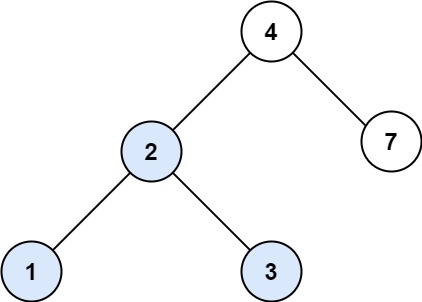
Input: root = [4,2,7,1,3], val = 2
Output: [2,1,3]
Example 2#
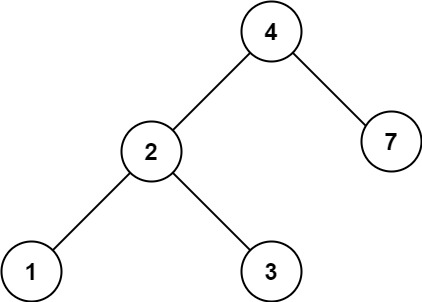
Input: root = [4,2,7,1,3], val = 5
Output: []
Constraints#
The number of nodes in the tree is in the range
[1, 5000].1 <= Node.val <= 10^7.rootis a binary search tree.1 <= val <= 10^7.
Solution 1: Recursive approach#
To solve this problem, you can leverage the properties of a binary search tree. In a BST, for any given node:
The left subtree contains only nodes with values less than the node’s value.
The right subtree contains only nodes with values greater than the node’s value.
Given this property, you can use a recursive approach to search for the node:
Start at the root node.
If the
rootisnull, returnnull(base case).If the
root’s value equalsval, return theroot.If
valis less than theroot’s value, recursively search the left subtree.If
valis greater than theroot’s value, recursively search the right subtree.
This approach ensures that you efficiently find the node or determine that it does not exist in the tree.
Code#
#include <iostream>
// Definition for a binary tree node.
struct TreeNode {
    int val;
    TreeNode *left;
    TreeNode *right;
    TreeNode() : val(0), left(nullptr), right(nullptr) {}
    TreeNode(int x) : val(x), left(nullptr), right(nullptr) {}
    TreeNode(int x, TreeNode *left, TreeNode *right) : val(x), left(left), right(right) {}
};
TreeNode* searchBST(TreeNode* root, int val) {
    if (root == nullptr || root->val == val) return root;
    if (val < root->val) return searchBST(root->left, val);
    return searchBST(root->right, val);
}
void printNode(TreeNode* root) {
    if (root == nullptr) return;
    std::cout << root->val;
    if (root->left) {
        std::cout << ",";
        printNode(root->left);
    }
    if (root->right)  {
        std::cout << ",";
        printNode(root->right);
    }
}
void printTree(TreeNode* root) {
    std::cout << "[";
    printNode(root);
    std::cout << "]" << std::endl;
}

int main() {
    TreeNode one(1);
    TreeNode three(3);
    TreeNode two(2, &one, &three);
    TreeNode seven(7);
    TreeNode four(4, &two, &seven);
    // Example 1
    printTree(searchBST(&four, 2));
    // Example 2
    printTree(searchBST(&four, 5));
}
Output:
[2,1,3]
[]
Complexity#
Runtime:
O(log n), wherenis the number of nodes in the tree. This is because, in the best case, you halve the search space at each step.Extra memory:
O(1)as you are not using any additional data structures that grow with the input size.
Summary#
Understanding BST Properties: This solution leverages the properties of BSTs to efficiently search for a node. Understanding these properties is crucial for solving similar problems.
Recursive Approach: The recursive approach simplifies the problem by breaking it down into smaller subproblems. Each recursive call handles a smaller part of the tree.
Base Cases: Handling base cases (e.g., when the root is
nullor the node is found) is essential to avoid infinite recursion and ensure correct results.
Solution 2: Non-recursive (iterative) approach#
You can use a loop to traverse the tree instead of recursion.
Code#
TreeNode* searchBST(TreeNode* root, int val) {
    while (root != nullptr && root->val != val) {
        if (val < root->val) {
            root = root->left;
        } else {
            root = root->right;
        }
    }
    return root;
}
Key takeaway#
Iterative Approach: The iterative approach avoids the overhead of recursive function calls, which can be beneficial in environments with limited stack space.
Efficiency: Like the recursive approach, the iterative solution is efficient with a time complexity of
O(log n)for balanced trees.Practical Application: Understanding both recursive and iterative approaches provides flexibility in solving tree-related problems, which is valuable in coding interviews and real-world applications.